Send for me some Scarlet Ribbons…

As a child I was obsessed with the colour red. My first pair of shoes, that I can remember, were red Mary Janes from Clarks. I even refused to take them off to go to bed! I had red trousers, red anorak, red jumper and the trademark of my youth, a red ribbon for my ponytail. I was a whizz at the local gymkhana and then later I took part in show-jumping competitions on my horse, Red River. I made a red velvet brow-band for him with matching velvet for my ponytail. He was already named after the river in the southern states of America, so that was pure coincidence.

This memory of red ribbons was triggered by a book I’ve just finished, 12 Years a Slave by Solomon Northup. In the book he describes how the slave women instead of spending their Christmas cents on tobacco – as the men did – almost universally spent it on ribbons for personal adornment. Without exception they chose the colour red. Red is traditionally the colour of passion, lust and love. With Valentine’s Day approaching splashes of scarlet can be seen in many shop windows, selling love in the form of chocolates, cards, flowers and other racier items!

But red can also be sinister and dangerous, suggesting violence and death. Would ‘Little Red Riding Hood’ have had the same underbelly of menace if it had been called ‘Little Green Riding Hood?’ Anyone who has seen the red-hooded dwarf in ‘Don’t Look Now’ will never look at a child’s red rain or duffle coat in the same way again. Hunting pink, worn by hunt staff, is an echo of Britain’s colonial past, and perhaps hints at the blood to be shed during pre-ban foxhunts.

So, what’s your favourite colour? Does any other colour have as many emotional connotations as red?

Posted in Uncategorized | Tagged , , , , , , , , | 4 Comments

Year of the Horse

On January 31st 2014 we enter the Chinese year of the Horse. The horse is an auspicious sign for all of us but for me especially. I grew up with ponies and horses and have always felt happiest with horses nearby. Although I love living in Amsterdam, more contact with the natural world and in particular with horses is something I yearn for.

This year, the theatre production, War Horse is finally coming to Amsterdam! Firstly, the original English production will be simulcast at Tuschinski on 27th Feb and then for the Holland Festival the Dutch production will run throughout the summer at Carré. I’ve got my tickets already for both events! I saw the production in London and it was the most moving piece of theatre I have ever seen. It’s amazing how quickly one suspends disbelief and the puppets become real horses, living and breathing on stage. Visceral in its immediacy, emotional without being sentimental and especially poignant this year during the commemoration of 100 years since the outbreak of World War I.

To celebrate wonderful equine friends and family, I want to share a favourite poem with you. It conjures up cosy evenings spent with my family in the seventies, watching the Horse of the Year Show. Each year during the closing ceremony, a horse would stride out into the spotlight of Wembley arena, stand still and the audience would hush. The mellifluous tones of the late, great Dorian Williams would recite this ode by Ronald Duncan,

The Horse

Where in this wide world can man find nobility without pride,
friendship without envy, or beauty without vanity?
Here where grace is laced with muscle and strength by gentleness confined.

He serves without servility; he has fought without enmity.
There is nothing so powerful, nothing less violent;
there is nothing so quick, nothing more patient.

England’s past has been borne on his back.
All our history is in his industry.
We are his heirs;
He is our inheritance.

© the Ronald Duncan Literary Foundation

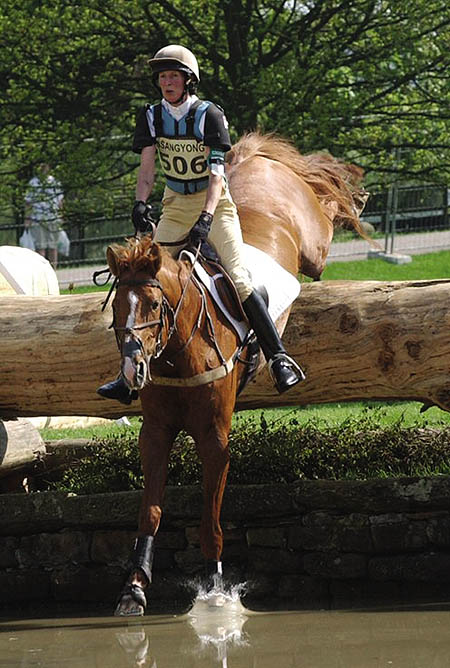
My sister, Christine Hardinge on Crown Derby

My sister, Christine Hardinge on Crown Derby

Posted in Uncategorized | Tagged , , , , , , , , , | 4 Comments

2013 in review

The WordPress.com stats helper monkeys prepared a 2013 annual report for this blog.

Here’s an excerpt:

A New York City subway train holds 1,200 people. This blog was viewed about 6,100 times in 2013. If it were a NYC subway train, it would take about 5 trips to carry that many people.

Click here to see the complete report.

Posted in Uncategorized | Tagged | Leave a comment

Christmases Past

Christmas is a very poignant time of year, isn’t it? And as one gets older, it gets worse, remembering the people no longer around to celebrate it with you. As a child, I believed in Santa Claus for a long time. I got a stocking full of presents from Santa (laddered stockings, Santa didn’t have time to get his nails done, obviously). Then there was a big present at the end of the bed that wouldn’t fit inside the stocking, and downstairs under the tree, at least two presents each from Mum, my stepfather and my sister. My stepfather didn’t do Christmas shopping so Mum, Chris and I had to buy presents for and from him to each other.

Cooking Our Goose
We didn’t mind. Harold had other Christmas duties, and one that he really loathed; slaughtering our flock of geese. The gander was always called Charlie. It took me a while to figure out that Charlie was not the same gander year in, year out. In the spring Harold used to go to Hereford livestock market and come home with a cheeping cardboard box, full of fluffy yellow goslings. Occasionally he’d also buy bizarre things like home-made parsnip or gooseberry wine which he used to give to guests who were too polite to say how disgusting it was, while Harold sat sipping cider or whisky. He never touched the home-made stuff so why he bought it, will remain one of life’s mysteries. The Johnny Walker also came in handy to give him Dutch courage to go out and kill the fully-grown geese, come Christmas time. He swigged back a triple, then went out to do the job. He said the birds always sensed what his intentions were. Not that I was ever there to see it. No, I was happy enough to eat one on Christmas Day but thankfully, slaughtering animals is a man’s job.

Defending the Underdog
Harold was a Capricorn, he shared the same birthday with my husband and they both have a similar sense of justice, and a tendency to side with the underdog. When he was at school, Harold was often involved in school-yard fights. He took it upon himself to defend the weaker boys from the school bullies. He was caned regularly and saw corporal punishment as an occupational hazard. The trick was NOT to withdraw one’s hand and make sure the cane caught you on the fleshiest part of your palm. He said particularly cruel Masters would use a cane with barbs on, although this might have been one of his stories. Like the best storytellers, he was fond of exaggeration.

Love at First Sight
When my blood father died, I was only three years old but the baronet, Sir Cotterell, allowed us to stay at the farm in Herefordshire for a while before giving us the boot and handing the farm over to my uncle. Even though I was tiny, I remember Harold rattling up the farm drive in a car with a horse trailer hitched behind. He lowered the ramp and there was the most gorgeous creature I’d ever seen in my whole life. A grey Welsh Mountain pony! He’d been caught wild on the Black Mountains and broken in by a local farmer. Harold had bought him for me as my first riding pony. I remember somebody putting me on his back and walking us down the farm lane and back. My clothes were covered in white hairs but I didn’t care. Nothing could have made me happier than that pony. I learned to ride on Tim, and even before I could say the word canter, I called it tanter, I was out in the field attempting it. Every time he broke into a canter I would tumble off. Tim would stop immediately, look down at me as if to say ‘what are you doing down there,’ and start grazing. Harold would come and pick me up, put me back on and the whole process would start over. I wonder if I learned to say canter correctly before or after I learned to do it!

I hope you have a Happy Christmas wherever in the world you are, and cherish your loved ones while they are with you, because nothing in this world lasts for ever…

This slideshow requires JavaScript.

Posted in Uncategorized | Tagged , , , , , , , , , | 1 Comment

Looking for a Present for an Ex-pat?

2013-11-07 15.09.46

Four contributors celebrating at de Hollandsche Manege

‘Foreign and Far Away’ by Writers Abroad will make the perfect gift! This tantalising collection of short stories, real life experiences and poetry will make the ideal read for anyone who has an adventurous spirit! It can be ordered online for just over seven pounds at Amazon.co.uk or for just over nine dollars at Amazon.com Here is an extract from my short story included in the anthology:

Going Native

Cor rolled up his knee-length shorts, unbuckled his sandals and stripped off his socks before running into the lake. The shallow, lapping water cooled him in the tropical afternoon. Shoals of tiny fish darted around his legs and damsel flies skimmed over the water’s dark surface. A burst of chatter came from the shore. A bunch of barefooted Indonesian children were sniffing around his stuff. One of them tossed the sandals to his chums and waved the socks back and forth above his head, as if they were flags. The others threw back their heads and laughed. Cor shook his fist and lolloped through the water in pursuit of the boys, but they disappeared into the mangrove’s shadow. A butcherbird flew overhead and squawked, joining in the derision.

Cor ran towards the trees, but as the sweat gushed off him he thought better of it. Good riddance, he thought, who needs socks and sandals anyway. It was a ridiculous school rule that he had to obey. It was just his bad luck that his dad was home on leave, so he’d probably get a hiding for losing part of his school uniform. Soon enough though he forgot his cares, relishing the freedom of walking barefoot along the dirt track and stopping every so often to wiggle his liberated toes.

The maid, Rikki, was sweeping the veranda floor. She beckoned to him as he walked up the steps. Pointing at his feet, she put her index finger against her lips and shushed. She took his hand and they went up the stairs to the linen cupboard and she found him some clean socks. Cor got his brown lace-ups from his room and put them on, going along with the charade. If his father hadn’t been home, none of this would have been necessary. He clunked downstairs, missing the freedom of bare-soles and sat in the cane chair on the veranda.

Music drifted from the bungalow window. Tante Leen singing, ‘Diep in Mijn Hart.’ Cor’s mum often played the record on the wind-up gramophone before dinner. In the garden his sister, Gerda, picked a hibiscus flower and put it behind her ear. She waltzed around with an imaginary dance partner. Why are sisters so utterly ridiculous, Cor asked himself. If he had a brother they could be playing football or pretending they were knights and having jousting matches, not dancing to soppy Dutch songs. He stood up and grabbed the broom Rikki had left on the veranda. He tiptoed down the steps, watching his sister all the time. She was lost in her own fantasy world. Cor squatted down behind the rhododendron bush. He wriggled through its branches and just as Gerda danced by, he stuck out the broom handle. She stumbled but managed to save herself by grabbing the edge of a garden table. He quickly withdrew the broomstick and crouched very still while Gerda looked on the ground for whatever had made her falter. Cor extricated himself from the bush, dusted off a few spare leaves, crept back up the steps and sat down in the chair as if nothing had happened.

From the kitchen wafted a smell that turned Cor’s stomach. Vomity sock smell. A while back he’d thrown up over his feet at school and tossed the sick-soaked socks in the back of the cupboard when he’d got home. A few months later he’d found them and the smell reminded him of the food he loathed. Caul-ee-flower, even the word left a bitter taste in his mouth. What kind of people lived in Holland where his father sailed to? And why did they eat a blubbery vegetable that looked like the pickled monkey brain the biology teacher had showed them? Worst of all, why on earth did his father have to bring it back and insist on sharing it with them?

Want to read on, then buy the book! 

Dutch Colonial Veranda

Posted in Uncategorized | Tagged , , , , , , , , , , , | 3 Comments

Downton Abbey Goes Dutch

I like to think I would have enjoyed being an Edwardian lady of the landed classes. I love elegant clothes, sewing, reading, writing letters, the countryside and horse-riding. Knowing my luck though, and given that I come from a farming background I probably would have ended up working below stairs, having to get up early to fire up the house and scrub and darn till my fingers bled or something equally gruesome. Both my granny and great-granny were in domestic service and without disclosing too much of their personal details, they had a rough old time of it.

But nowadays a girl can dream and have ideas above her station! Last week I visited a former colleague who lives in the picturesque village, de Steeg in the province of Gelderland. I Googled B&Bs and found a link to Kasteel Middachten. Always having wanted to stay in a castle, I booked two nights in the newly renovated, former stables.

Before arriving we went for a walk in the Posbank, a wooded, hilly area in de Veluwe, a national park which I blogged about here. The autumn colours were truly stunning and we were fortunate enough to have dry and sunny weather. After a heidelunch in Paviljoen De Posbank, we set off for a walk stopping on the way to collect chestnuts and photograph mushrooms. It felt like we had entered a magical world, the golden sun filtering through the trees and the whispering sound as the leaves fell.

After arriving at the Castle, we were given a very hearty welcome and our friendly guide, Ria gave us a brief history of the building. It was built in the 12th Century and is still in private ownership, having passed down the male and female lines of just a few families right up to the present day! The Castle isn’t officially open to the public, only on special occasions, but as we were staying two nights we were given a guided tour on the morning of our departure. More details about the history of the Castle and estate can be found on this site, www.erfgoedlogies.nl

On the way to our room above the stables, we walked through the tack room where the leather collars and harnesses for the carriage horses are still kept. The smell of leather took me right back to my childhood and I felt instantly at home! You can take the girl out of the farm, but you can’t take the farm out of the girl; Lady Mary Crawley, I ain’t!

Posted in Uncategorized | Tagged , , , , , , , , | 6 Comments

De Nieuwe Wildernis – Putting a demon to rest

This week I saw the nature film, de Nieuwe Wildernis in Tuschinski. It covers a year amongst the flora and fauna of the rewilding project in de Oostvaardersplassen. A herd of Konik horses (extremely hardy Polish breed) provide the narrative, a black filly foal supplying the emotional highs and lows of this beautifully filmed piece. The film is not without controversy however.  The herd animals are kept within a huge but enclosed space and because of the lack of grazing in winter many of them die of starvation and their carcasses are left to be scavenged.

Horses are for most of us, domesticated animals that require human care. The film shows a wildness that is lacking from the over-manicured Dutch landscape and you could argue that it’s impossible to have that glimpse of wildness without inherent animal suffering. Having grown up on a farm, amongst ponies and horses, it’s deeply instilled in me that we should care for animals when they’re sick and feed them when they’re hungry.

In one of the scenes a foal gambols in the spring sunlight and, imitating its elders taking a cool mud bath, frolics into the ditch and gets stuck in the quagmire. Eventually he manages to break free but by then the sun has gone in, the foal cools off and lies down on the bank, exhausted. The rest of the herd gather round and start pawing at him to get up. Running with the herd is essential to a prey animal’s survival and this instinct to get foals on their feet is a built-in reflex.

A long-buried, dark memory from my childhood on the farm surfaced after watching this scene. I was about eleven or twelve, at home alone. Myra, our alpha brood mare was away visiting the stallion. Her offspring and some geldings that my sister and I rode for show-jumping were turned out in the field together. It was springtime and the horses were restless without their matriarchal leader. Our flock of pregnant ewes was out in the field too, and from the farmhouse window I saw that one of them had lambed. Nothing more than a white dot, the lamb lay still on the ground and the horses quickly circled around, pawing at it in what looked like a sadistic game. I grabbed my step-father’s wooden stick and ran down to the field shouting at them. I was boiling over with rage and disbelief at their cruelty. By the time I got there the blood-covered lamb was dead from its injuries, its frantic dam and I could do nothing to save it.

Until now, I have never understood why the horses ‘killed’ this lamb. But after watching that scene from de Nieuwe Wildernis, something clicked into place. Their pawing at the lamb was the adult horses’ instinct taking over. A young animal needed to stand up and run with the herd. Mares are often brought into the stable to foal, or they foal at night so I never knew about this pawing behaviour. After all these years I could forgive them, for that alone I am very grateful to this film. Whatever your feelings on rewilding projects, I urge you to go and see this movie before you pass judgement!

Posted in Uncategorized | Tagged , , , , , , , | 2 Comments

Woman in Blue Reading a Letter

Sometimes it’s lovely exploring your home town, isn’t it? Last weekend the hub and I set off in beautiful autumn sunshine towards de Oude Kerk in the Red Light District. Awesome is a tragically overused word but the light inside the church was so spiritual, that it truly was awesome in the old-fashioned sense, i.e. it inspired awe in the beholder. The golden autumnal light flooding through the plain glass window, so typical of a Calvinist church, was profoundly moving.

As I looked out of the window from a side room in the church I saw a backpacking tourist agreeing a price with one of the girls who works in the windows surrounding the Oudekerksplein. Where else in the world could one witness such a mundane and yet age-old transaction from inside a church? Only in the Netherlands, where spiritual and physical appetites are catered for in the same neighbourhood, De Wallen. 

After having Dutch apple pie in the very pretty church courtyard we hopped on our bikes and crossed the water by ferry and visited The Eye Film Institute, our favourite haunt this summer/autumn. After that we cycled towards the NDSM werf and stumbled across a pop-up event, Vintage per Kilo, and it works like this; a load of vintage and second hand quality clothing is displayed in an old building, last weekend it was the Schram Studios, at the door you collect a plastic bag, fill up with goodies, have your goods weighed and pay per kilo. Simple as that, just like buying veg in a grocer’s! I found a fabulous seventies dress (fits like a glove) and a pair of Magli (Italian makers) brogues. After that we wandered on down to Van Dijk & Ko, Amsterdam’s largest stockist of brocanterie. In a nutshell, another super day discovering and rediscovering old and new places and events in this wonderful city!

Posted in Uncategorized | Tagged , , , , , , , , , , | 1 Comment

Eye Eye, Me Hearties

A while back, I celebrated my birthday and my husband organised a lovely day out at the EYE Film Institute. We went to the Fellini exhibition, watched the remastered version of ‘ Jour de Fete’ starring the legendary Jacques Tati and had dinner on the terrace overlooking the water. What more could a girl want?

Previously centrally located in a 19th century pavilion in the Vondelpark, the Dutch Film Museum merged with three other film institutions and was renamed The EYE Film Institute, Netherlands in 2009. In April 2012, the Queen opened the new museum. The EYE Film Institute has become one of the main attractions of the Dutch capital. The striking building was designed by the Viennese architectural firm, Delugan Meissl Associated Architects, most well known for building the Porsche Museum in Stuttgart.

The EYE overlooks the Ij (pronounced Eye) Lake which separates the centre of Amsterdam from north Amsterdam. The Ij was formerly a bay in the Zuiderzee and its unusual name is derived from the Fries word for water; Aa, Ee or Die (an indecisive lot, it would appear, the Friesians). The ferry that crosses the water from behind Central Station is free and we always recommend our guests take their bikes on the ferry to North Amsterdam. It has a totally different feel to the rest of the city. Within a few minutes you find yourself in lush green countryside, or if you’re a culture vulture, I recommend you head towards the EYE. Entrance to the building is free and there’s loads to do there. You can dine, watch a film, or visit the Fellini exhibition which runs until 22 Sept 2013.

Posted in Uncategorized | Tagged , , , , | Leave a comment

Dungeness, Dr Syn and Derek Jarman’s Garden

Last week, I holidayed in good old Blighty. Scuppered by a four-hour delay on a Belgian motorway, which meant we caught the ferry at 6 pm instead of 12 noon, the hub and I were too knackered to drive all the way from Dover to south Wales. Instead, we found a lovely family run hotel, Broadacre in New Romney on the south coast. Unaided by the sat-nav or internet we just followed our instincts! We booked into the master bedroom complete with four-poster bed and room to swing a pony…

In the entrance hall of the atmospheric hotel, hung paintings of local legend, Dr Syn. His spooky Phantom-of-the-Opera appearance and intriguing life as a parson-cum-smuggler prompted me to download the novel, Doctor Syn on the High Seas, onto my Kindle. It’s proving a swashbuckling romp with dastardly landowners, rascally pirates and a hot Spanish senorita thrown in for good measure. Having become weary in the past few months of writers being far too clever with multiple story lines, jumps in time and incomprehensible plots, it’s refreshing to read a linear story of revenge. After marrying the woman of his dreams, Doctor Syn is cuckolded and his Spanish wife hightails it off with a younger, better looking man. What she saw in Dr Syn in the first place is beyond me, but heigh-ho, you pays your money and you takes your chance.

After a restful night in the four-poster, I awoke refreshed, all memories of sleepy Belgian lorry drivers banished from my memory, and set out to explore the single-street metropolis of New Romney. My ever garrulous hubby got chatting to a local, who recommended we visit Dungeness. Famed for its lighthouse, shingled beach, artists’ community, Derek Jarman’s garden and the best fish & chips in England! (We’ll forget about the nuclear-power station for now.)

Dungeness is a haunting place, quite unlike any coast I’ve ever visited in England. The light is harsh and strong, the sound of the waves over the shingle relentless, and its unusual ecosystem of alien-looking plants give the sensation of having stumbled into an otherworldly place. First stop was Derek Jarman’s, Prospect Cottage. The film director bought the cottage and created its surrounding garden, after he had been diagnosed with cancer. I confess I’ve never seen a DJ film but I’ve heard loads about his garden. It’s not officially open to visitors but it’s possible to walk around it and take photos. The windows were obscured with blinds and there was an air of sadness and desertion in the air. I believe it is now privately owned but there was little trace of human activity, apart from the well-tended garden.

Jarman died of aids in 1994 and had to spend his final days in a London hospital, away from his beloved coastal home. This article in The Guardian is very movingly written by Howard Sooley, and it tells of the film-director’s demise, his passion for Dungeness, the natural world and how he loathed the sterile hospital environment where he was forced to spend his last days on earth.

The poem on the black timber wall of Prospect cottage is from John Donne’s The Sun Rising and reads:

Busy old fool, unruly Sun,
Why dost thou thus,
Through windows, and through curtains, call on us ?
Must to thy motions lovers’ seasons run ?
Saucy pedantic wretch, go chide
Late school-boys and sour prentices,
Go tell court-huntsmen that the king will ride,
Call country ants to harvest offices ;
Love, all alike, no season knows nor clime,
Nor hours, days, months, which are the rags of time.
In that the world’s contracted thus ;
Thine age asks ease, and since thy duties be
To warm the world, that’s done in warming us.
Shine here to us, and thou art everywhere ;
This bed thy center is, these walls thy sphere

After feeding our souls we set off to the Britannia Inn to feed our bodies and I wouldn’t like to say they serve the best fish and chips in England, but they’re probably not far off. After sating our appetites we decided to work off the calories by walking up the 180 steps of the old lighthouse.  We were rewarded with spectacular sea views. As the sun came out, a huge rabble of butterflies flew up into the air, their dancing forms luminous against the silvery green of the plants. I was reminded of a hymn chosen for Jarman’s funeral, a favourite from his childhood, All Things Bright and Beautiful. 

Posted in Uncategorized | Tagged , , , , , , , , , | 4 Comments