Queen of the Gymkhana -Then and Now

When I was a gal I was pony mad and during summer weekends went to horse shows to compete in gymkhana and show jumping competitions. My sister, Christine Hardinge was the first one to get the horsey bug and aged about four I followed in her slipstream. She has made a career from horsemanship alongside her husband, Colin. Her career boasts major successes at top three-day-events and she has competed and won prizes at Badminton Horse Trials which most riders can only ever dream of achieving. See her impressive eventing credentials here.

Recently, I’ve felt very nostalgic for those bygone, halcyon days of the gymkhana and have taken up show-jumping again. I have weekly lessons at the Hollandsche Manege and my sister, Chris recenly let me have a little jump around her school at home on the lovely, Crown Meteorite aka, ‘Rocket.’ See film above.

When I was in my teens I was very brave and the height of the jump never bothered me. In fact the higher the better. Nowadays, I’m quite a bit more cautious and riding-school horses are a whole different ball game anyway. The secret to show jumping over bigger fences is establishing a relationship of mutual trust with your horse and this is difficult with just weekly contact. The horse and you need to know each other so well that you become one unit. When that trust is established, the rider feels the sensation of flying over fences which makes show jumping such a satisfying and thrilling sport.

Below a photo of my old 14.2 h.h pony, The Baron XI. After competing in the juniors I went on to compete in seniors with the love of my life, Red River V, a 16 h.h bay thoroughbred, pictured right.

Posted in Uncategorized | Tagged , , , , , , , | Leave a comment

Keukenhof: The Flower Paradise You Must Visit in 2025

plus 10 surprising facts about tulips.

  1. The tulip originated in Turkey and was named after the traditional tulip-shaped turban.
  2. Sixty percent of the world’s bulbs come from the Netherlands and three-quarters of all global trade in flower bulbs passes through NL.
  3. Export value of Dutch bulbs is approx. 600 million euros annually.
  4. It takes 7-12 years to cultivate a flowering bulb from a seed. This slow growing process partly fuelled tulip mania in the 17th Century.
  5. In the early 1600s tulip mania gripped the Dutch. Bulbs were traded for extortionate amounts of money. Often the bulbs were ‘virtual,’ passing from speculator to speculator, but never physically changing hands.
  6. The much-coveted ‘broken’ variety (with striped petals) which fetched the highest prices during tulip mania were the result of a virus in the plant.
  7. The world’s first economic bubble burst in February 1637 in Haarlem, possibly triggered by the outbreak of bubonic plague in the city.
  8. Author Deborah Moggach (author of the Best Exotic Marigold Hotel) wrote ‘Tulip Fever’ (inspired by point 5) I highly recommend this novel if you like your fact peppered with fiction!
  9. In WWII, many Dutch citizens were forced to eat tulip bulbs during the famine of 1944. This period is known in Dutch as the hongerwinter. Usual food supplies were either blocked or diverted to Germany. Eighteen thousand people died of malnutrition during the exceptionally hard winter.
  10. The Keukenhof attracts around 1.5 million visitors each year. You have from 20 March till 11 May 2025 to visit this cornucopia of flowers covering 70 acres!
Posted in lifestyle, travel, Uncategorized | Tagged , , , , , , , , | 6 Comments

Wellies or Flip-flops?

Yes, the festival season is upon us. I’m not usually one for muddy fields, improvised toilets and lots of hubbub but this year I have booked two literary festivals! Firstly, the legendary Hay Festival in the Welsh Marches. Growing up in the Wye Valley I remember Hay-on-Wye as a tiny market town on the verge of dereliction. In 1893 my grandparents’ marriage was registered in Hay so family connections in the border area run deep. But to me it was always a sad place where out-of-fashion Welsh Mountain ponies were auctioned for a knock-down price to the meat man.

Embed from Getty Images

But then in the 1970s entrepreneurial hippy (Oxymoron?) Richard Booth declared himself the King of Hay, and Hay an independent Kingdom of Books! Suddenly Hay became a destination. Hats off to the self-appointed King, he kept out corporate investors and big retail chains ensuring the town comprised independent traders that serve a lively community where sheep farmers rub shoulders with Y-generation idealists. And the cherry on the cake, the annual descent of the world’s literati each spring. My line up for Hay Festival includes; Michael Morpurgo, Meera Syal, Helen MacDonald, Marcus Brigstock and an African and Welsh harp concert.

Then, in the autumn, and I’m already quaking in my flip-flops, I’ve enrolled for the York Festival of Writing. A mind-exploding selection of workshops awaits me AND two ten-minute slots with agents where I can pitch works in progress. But which WIP to choose of my six Nano projects? Or a totally new idea altogether? My business English students have to prepare an elevator pitch for their homework and I’ve decided I need to join them. I found this short session by Michael Hyatt especially useful for writers. https://www.youtube.com/watch?v=-t1ar_IpmUU

So what’s on your festival agenda this year? Will you be donning silly footwear or slip on your old faithfuls and stay home?

Embed from Getty Images

Posted in Uncategorized | Tagged , , , , , , , , , , | 2 Comments

Parrots and Mermaids in het Stedelijk

The Oasis of Matisse is the largest-ever retrospective of work by Henri Matisse (1869-1954) to be shown in the Netherlands. The exhibition traces the multi-sided talent and artistic development of Matisse from his early work through to the dazzling cut-outs of his later years.

When I studied textiles at Goldsmiths in the eighties, Matisse’s work was very much looked down upon as merely decorative and lacking content and depth. Many textile students were accused of ripping-off his line drawings and two dimensional patterns in an attempt to cover up their lack of talent. Sexism was rife in those days, the largely male-dominated fine art department looked down on its poor, female cousins in the textile department. I admit to joining the anti-Matisse brigade in an attempt to appear cool and superior to artists who were only capable of making decorative pieces. Through the years though, I’ve mellowed and on Friday at the opening day of his retrospective in het Stedelijk, my soul soared with Matisse’s in his delight of pattern and colour. I felt emboldened by his refusal to give in to negativity and the physical restraints of illness and old age.

The exhibition comprises two parts. On the ground floor Matisse’s work is placed in direct dialogue with notable works by van Gogh, Picasso, Cezanne, Delauney, Chagall, Sluiters and many others. The top floor is devoted to his later cut-outs which he created when he was confined by illness at home. I particularly love his monumental cut-out piece, The Parakeet and the Mermaid.

Embed from Getty Images

Matisse has pinned cut-outs all over the walls of his home. When he opens a window, the shapes tremble in the breeze. Matisse says: “I have made a little garden around me, where I can walk.”

On the mezzanine floor there’s a workshop area where you can have a go at creating cut-out pictures yourself. Suitable for children aged 8 to 88 years. 🙂

The exhibition at the Stedelijk runs until August 16th 2015. Timed entry possible with pre-booked, online tickets. Entry fee, 20 euros or supplement to Museum Card, 5 euros. DO NOT MISS!

Posted in Uncategorized | Tagged , , , , , , | 2 Comments

Ladies & Gentlemen, March 19, 2015

So pleased to be selected to have my story performed on March 19th in Leeds. Go if you can!

richardsmyth's avatarLiars' League Leeds

Liars’ League Leeds is delighted to present another night of marvellous storytelling. This Thursday, our Ladies & Gentlemen event takes you behind the scenes at the Coney Island freakshow, into the inner sanctum of the mysterious Cimmerian Club, to a romantic dinner-party for, uh, six, and up on stage for a stand-up’s worst nightmare…

For your entertainment and edification, we will be reading…

A Sideshow Story by Joe Saxon
Grim by Liam Hogan
The Comeback by Rosalind Stopps
The Cimmerian Club by Susan Carey
Knights Round A Table by Elizabeth Hopkinson

Also, FREE BOOKS! (if you are clever enough to triumph in our almost-famous half-time books quiz.)

You can find us at the wonderful Crowd of Favours pub on Harper Street, Leeds: https://www.facebook.com/TheCrowdOfFavours

Entry is FREE, FREE I tell you! Roll up on Thursday, March 19 from 7pm and – once we’re all sitting comfortably – we’ll…

View original post 15 more words

Posted in Uncategorized | 2 Comments

Getting in a Pickle!

On 14 and 15 March an Iamsterdam event is taking place called, 24H Amsterdam. All sorts of enterprises and entrepreneurs are opening their doors to public who might not usually get a chance to sample their services or wares. One of these events was the opportunity to sniff around the local pickle factory. Kesbeke have been pickling onions, gherkins and piccallili in Amsterdam since 1948. It’s a family-run enterprise. They started small, selling their hand-bottled products as street traders; taking their pickles on wooden handcarts and selling them in all the neighbourhoods of Amsterdam. The Kesbeke logo incorporates the three crosses which are part of Amsterdam’s coat of arms. The business is also run under the triple-p concept which means making a profit but also taking into account peoples’ needs with respect for the planet’s resources.

Kesbeke+logo+2

With the current trend for locally-sourced products, Mr Kesbeke and his crew were overwhelmed with the amount of visitors wanting to learn more about their factory on the 24H Amsterdam open day. Fortunately our group also had about 10 minutes with Mr Kesbeke himself who still has a passion for sharing his extensive knowledge of the pickle trade.

Only ten people work on the factory floor but in one day they can process a mind-boggling 100,000 jars of pickles! Their signature product is pickled gherkins. Gherkins grow in sub-tropical climate and are all picked by hand and then shipped to Holland for processing. First they are washed, then potted, then vinegar and sugar are added and finally the product is pasteurised to kill all bacteria. They then go to the warehouse where they are labelled and eventually delivered. There is also a shop opposite the factory entrance where they sell more artisan products as well as their usual fare; Fijne Tafelzuren b.v., Adolf van Nassaustraat 2-8, 1055 RP Amsterdam

Kesbeke pickles is a national product, only sold in the Netherlands although there is a growing market in Saudi Arabia?! In the old days there were ten pickling companies in Amsterdam but now Kesbeke is the only remaining one. Nice to know there’s a thriving company employing local people on one’s doorstep. So the next time you spice up your meal with some picallili, spare a thought for all the people who have worked hard to bring it safely and tastily to your plate.

Posted in Uncategorized | Tagged , , , , , , , , , | Leave a comment

FREE magazine by Writers Abroad

Hooray, it’s here; the second edition of Writers Abroad Magazine. Spring has sprung and a feast of FREE reading awaits you! Tickle your romantic taste-buds with short stories of love lost, love promised, love yet-to-blossom and love totally flabbergasted. The flabbergasted one was penned by yours truly. A husband reveals a secret no wife should ever have to deal with.

It also includes; a quick and tasty recipe for summer canapés, poetry that will make you see the so-called ordinary from a fresh perspective, book reviews, an interview with poet and novelist Sue Guiney, the ups and downs of living in France, a disastrous but funny camping holiday and two of our members reveal how living in rural northern Ireland and Yokohoma, Japan has influenced their lives and writing. Oh and asides from that the pleasures and embarrassments of visiting an onsen (hot spring) in Japan are shared, also the evolving nature of English is discussed and to cap it all, a short grammar lesson for language students. Individual members’ writing careers and published books are also showcased.

Last but not least there is a chance to sign up for the call for submissions in our forthcoming anthology, Kaleidoscope. Are you an expat who writes FICTION or POETRY? Are you looking for a chance to be published and support our chosen charity, Room to Read? Our theme this year is light and we will be accepting submissions from May to mid-June. Make sure you don’t miss the boat and sign up via the link in the editorial section of the magazine.

To read online, click here or on the front page below. You can also download the magazine in PDF here The links will allow you to read the magazine on-line or alternatively download a PDF copy which you can read on your PC (including the Kindle app if you have it), tablet,  iPad or android device. The best way to read the PDF version is through a PDF reader app which are free to download.

Happy reading 🙂

150210_Title Pagejpeg

Posted in Uncategorized | Tagged , , , , , , , , , , , , | Leave a comment

Between Art and Kitsch

The Dutch have an ambivalent attitude to their own traditional blue and white Delftware. I rarely see it in Dutch homes, only in museums or tourists shops. The blue and white pottery leaves me a bit cold, but the tiles on the other hand I do really love. So much so that I was lucky enough to pick up a table top of Delftware tiles, 50 in total for quite a low price. Now, I am not known for my canny way with money, in fact, according to husband I have got ‘a hole in my hand.’ Not a medical condition, just a Dunglish expression roughly equivalent to the English proverb ‘money burns a hole in his/her pockets.’

Anyway, this time, I think I have come up trumps. I believe these tiles are around mid-eighteenth century, in decent condition and highly decorative. They show mainly trades and occupations, a rosy image of Holland with every citizen happily getting on with their work and occasionally having time for a drink, a smoke or flirting with the dairy maid.

The term, Delftware is derived from the Dutch town of Delft where from the seventeenth century potteries produced hand-painted tin-glazed pottery of high quality which was exported all over the world. Alongside their other wares, the potteries in Delft produced tiles but these were not a major product. Most Dutch tiles were manufactured in Rotterdam, Amsterdam, Utrecht, and Gouda. In northern towns such as Harlingen and Makkum tiles were often the main line of business.

Delftware tiles are eagerly collected. Their hand-painted illustrations provide a unique insight into life in Holland at the time. I saw a few for sale on an antique dealer’s stall at the Noordermarkt last weekend. They weren’t as old, or as decorative as mine and I was told they retail at between 40 and 50 euros apiece! So pretty soon you will see me on the Dutch Antiques Roadshow, Tussen Kunst en Kitsch and I’ll say ‘oh, I think they’re worth about 200 euros all together’ and the expert will say, ‘add a nought to that!’ Clutching my heart, I will be dumbstruck with shock and head straight for the nearest gin and tonic to quieten my nerves. Or failing that I will keep them and enjoy them for as long as I can.


Posted in Uncategorized | Tagged , , , , , , , | 5 Comments

Herefordian Through and Through

Touching Base
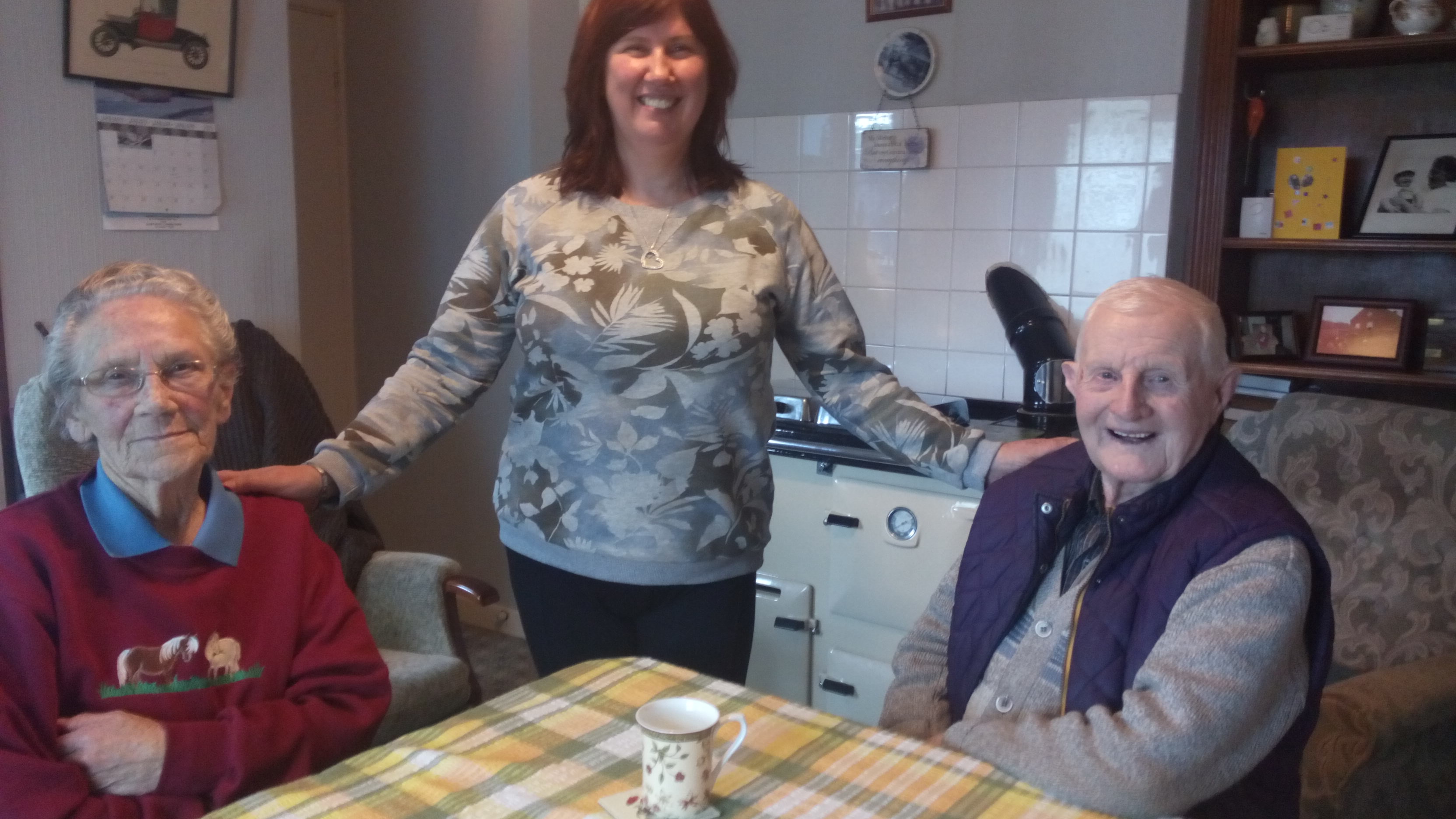
That’s part of being an expat. Sometimes you need to return to your real ‘home,’ and real people. Auntie Annie was born on a farm in Herefordshire, the second eldest of five siblings. In June she will be 89 years old and she still lives independently, does all her own housework and is the principle carer for Uncle John who suffered a stroke six years ago. They both maintain a vegetable garden and eat many of their own crops, keeping alive that vital contact with the earth that was their livelihood for many years. Auntie Annie has Hereford soil mixed in with her blood. She farmed all her life and has wonderful stories to tell about living on the land. One that I particularly remember involved two SAS soldiers.

IMG_20150124_140339

Who Dares Wins
Is the motto for the Special Air Services, based in Hereford since 1960. The SAS counter terrorist wing, largely a covert regiment of the British Army famously took part in a hostage rescue operation during the Iranian Embassy Siege in London in 1980. It was reputedly an SAS man who, while watching a rerun of the Embassy Siege on TV with the Prime Minister, asked Mrs Thatcher to move her ****ing head out of the way. More recently SAS troops have been sent to Syria, tasked with trying to track down the Islamist State terrorist group and in October 2014, the SAS began executing raids against ISIS supply lines in western Iraq, using helicopters to drop light vehicles manned by sniper squads. SAS claims to have killed up to eight ISIS fighters per day since the raids began

Lifting Bullocks
The endurance tests the SAS have to pass in order to join this elite force, take place on the Brecon Beacons and Black Mountains near the English/Welsh border where Annie and John farmed in Herefordshire. One blistering hot summer day while moving cattle across a road, one bullock decided the gate was for cissies and it was much more fun to jump the thick hedge. He miscalculated the hedge’s size and banked its width, straddling fore and hind legs either side. Attempts to drive him forward and off the hedge came to no avail. Tempers became frayed in the midday heat; a swarm of flies taunting the animal didn’t help much either. The bullock was becoming more and more distressed when the cavalry arrived in the form of two SAS men jogging down the road. They took off their stone-laden rucksacks (carried as part of the endurance test) linked hands underneath the animal’s belly and heaved the bullock forward and over the hedge. Without a backward glance the bullock bucked happily and went his merry way.

Concerned for the animal’s welfare, and clearly in touch with his softer side, one of the soldiers said, ‘Now, Missus, that animal has been traumatised and when you get him home he’ll need some calming down.’ Annie smiled, thanked the men and herded the beast into the field to join his mates. She and Uncle John then headed off home for a well-earned glass of home made beer. They told my cousin Rose what had happened. ‘Only someone from Off could come out with a line like that.’ Uncle John said, Traumatised bullock, my elbow, silly ole bugger more like!

Below a few pictures of the Black Mountains and Llanthony Priory.

Posted in Uncategorized | Tagged , , , , , , , , | 4 Comments

Shanks’s Pony Enjoys a Day at the Beach

My New Year’s resolution is more frequent use of Shanks’s Pony (Brit. idiom for walking) and I can’t think of a more picturesque and bracing place to do it than the North Holland coastline.  New Year’s Day in Holland was dismal and wet, so I took my traditional New Year’s walk on January 4 along the beach from Wijk aan Zee to the North Pier in Ijmuiden. The North Pier is a favourite spot for birdwatchers, I saw plovers and seagulls but a huge variety of sea birds can be seen here if you have the patience to stand and wait. The pier is only suitable to walk when the sea is behaving and it’s shut when the waves get above a certain height.

The world and his wife were out with their children and dogs so the two eateries that were open on the beach were heaving with people. Can you tell me why children turn public spaces into a playground? When I went to restaurants as a child I remember being told to shush for slurping through the straw of my milkshake too noisily. I wouldn’t have dreamed of getting up from my chair running riot and ambushing waitresses with lego like today’s offspring do. We headed into Wijk aan Zee and had a bite to eat at the lovely and civilized Gewoon in Wijk aan Zee They serve high tea or the traditional Dutch winter fare of erwten soep and chocolade melk. (Not usually consumed together!)

The Ijmuiden to Newcastle DFDS ferry shuttles mainly Geordies to and from the Netherlands for day trips or longer. Watch the ferry depart from De Kop van de Haven in Ijmuiden. This fish bowl restaurant is famous for its fish and chips, or kibbeling and patat as they call it here. Connexion Bus 82 from the Elandsgracht takes you all the way from Amsterdam to IJmuiden, or as I mentioned in this post, it’s FREE to park in Wijk aan Zee I guess I am a true Amsterdammer now, the way I luxuriate in any place that offers free parking! Although that’s the beauty of Shanks’s Pony (sometimes Shanks’s mare), you never have to park her anywhere 🙂

Posted in Uncategorized | Tagged , , , , , , , , , , , , | 4 Comments